Each of the fourteen articles below stands alone. You will find, in order: the article's number and title, its original wording quoted from the Constitution of the Living Nation, a deepened reading that draws out its meaning and its consequences, and a short list of key points to carry away.
Read straight through for the whole architecture, or jump to the article you need. The document is a chain — §1 grants the freedom, §2 locates its owner, §3 frames its duty, and §§4–13 build the house in which those three can be lived.
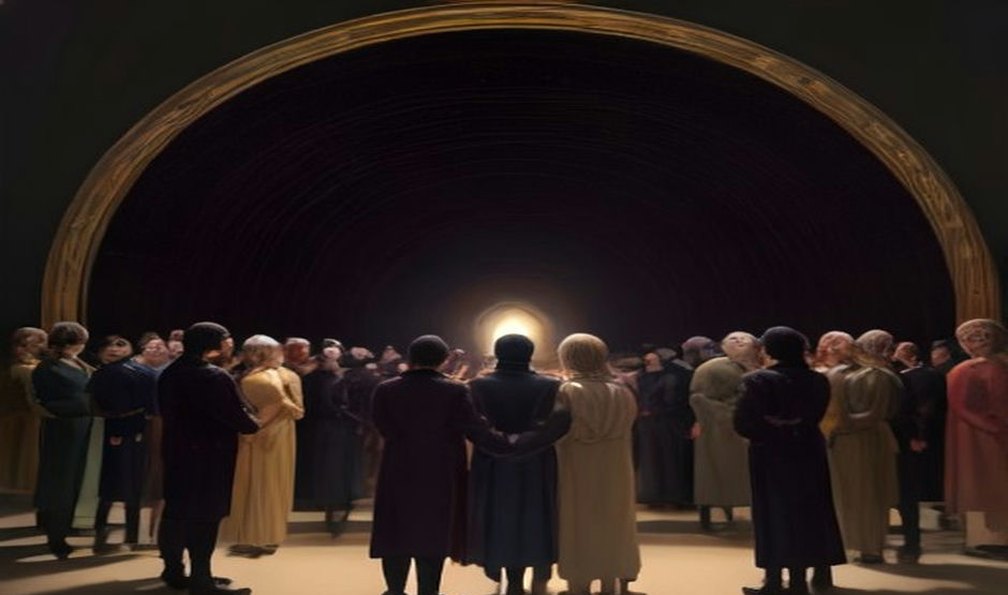
Where the Nation Declares Itself
We, the contracted living Men and Women of The Living Nation,
Recognizing our shared humanity and the need for mutual support and respect,
Affirming the inherent dignity and universal worth of every individual,
Determined to build a world where everyone can thrive, live with freedom, and contribute to society in harmony with planet Earth, our home,
Hereby establish this Constitution as the fundamental practices governing The Living Nation.
The Preamble is not decoration. It is the document's opening argument — the single page on which the whole Constitution rests — and it does three things at once.
First, it names who is speaking. Not a state, not a corporation, not an abstract "people," but "the contracted living Men and Women" of a nation that has chosen itself. The word contracted matters: belonging here is voluntary and consent-based, never inherited or imposed by birth, geography or paperwork. The word living matters just as much: this is an order built for real bodies and real minds, not for legal fictions, files and numbers.
Second, it states the premises the rest of the text will defend — shared humanity, the dignity and universal worth of every individual, and the determination to build a world where everyone can thrive in harmony with planet Earth. Everything that follows (§1's rights, §2's ownership of self, §3's stewardship) is simply these three affirmations turned into practice.
Third, it converts intention into obligation. "Hereby establish" is a performative act: by saying it together, the co-owners make the Constitution the fundamental practice governing their life together. The Preamble is the promise; the thirteen sections are how the promise is kept.
- Membership begins in consent, not in birth or bureaucracy.
- The measure of the whole document is a living, thriving human being.
- Prosperity is defined together with the health of the Earth — never against it.

Fundamental Rights
Every living human on earth, whether man, woman, or child, is universally unique.
Each individual is granted universal rights to live their life according to their own free will and to satisfy their needs, provided that they do not harm other individuals or damage the living space of planet Earth.
§1 is deliberately the first article, because everything else is downstream of it. It opens with a claim about what a human being is: universally unique. Not unique in the decorative sense of a personality trait, but unique as a matter of standing — every living human, man, woman or child, without exception, is one of a kind, and therefore irreplaceable.
From that claim flows the right. Each individual is granted the freedom to live their life according to their own free will and to satisfy their needs. Notice that this is not a licence handed down by an authority that could take it back; it is the recognition of something already true. Freedom of will is the default, and no justification is required to exercise it.
But the right is stated together with its own boundary, and the two cannot be separated. My freedom runs right up to the point where it would harm another individual or damage the living space of planet Earth. This is not an exception carved out of the right; it is the shape of a freedom that can be shared by everyone at once. A right that ignored harm would destroy itself within a generation.
The genius of §1 is its symmetry: it grants the widest possible liberty while fixing the smallest possible limit — harm to people and harm to the planet. Between those two guardrails, the individual is sovereign.
- Uniqueness is the foundation of standing, not a compliment.
- Freedom is the default; no permission is required to be free.
- The single limit is harm to others or to the Earth — and it applies to everyone equally.

Self-Ownership
Every living human fully owns themselves, including their body, mind, all images, and representations.
This ownership is subject only to valid agreements or judgments imposing specific limitations.
§2 answers a question most legal systems quietly get wrong: who owns you? Under the old order, the honest answer is often "not you." Your body is licensed to the state, your attention and data are harvested by platforms, your image is traded without your say. §2 begins by reversing that: every living human fully owns themselves.
The scope is drawn generously and precisely. Ownership covers the body — health, movement, lifestyle, the physical fact of you. It covers the mind — your thoughts, ideas, creativity and conscience. And it covers all images and representations — your likeness, your voice, your footprint in the world, whether a photograph, a scan or a digital model of you. You own your footprint.
Crucially, this ownership is inherent. It is not created by a contract or a certificate, so it cannot be dissolved by one. It can only be limited in two narrow ways: by a valid agreement you freely entered into, or by a judgment imposed after you harmed someone. In other words, the only things that can touch your sovereignty over yourself are your own consent, or a due process you helped constitute.
This is what makes §2 the keystone of the whole order. If a person owns themselves, they cannot be owned by a bank, a bureau or a monopoly — and a society built from self-owning people can only ever be a society of consent.
- You own your body, your mind and your likeness — inherently, not by permission.
- The only legitimate limits are your own valid agreements or a lawful judgment.
- Self-ownership is the legal seed of a society that cannot own its members.

Stewardship Responsibility
Every living human on Earth owns their portion of the planet and bears both individual and collective responsibilities for its stewardship.
§3 is the counterweight to §2. Having established that each person owns themselves, it now states that each person also owns a portion of the planet — and immediately adds that ownership is inseparable from responsibility.
The Earth is not framed as inventory to be consumed, but as a shared inheritance held in trust. To "own a portion" is to be its steward: to keep it alive, fertile and habitable, not merely to extract from it. Ownership without stewardship would be a race to the bottom; ownership with stewardship is a reason to care for what you hold.
The section deliberately names two levels at once. There is individual responsibility — the daily choices, consumption and conduct of a single person. And there is collective responsibility — what can only be done together: protecting watersheds, restoring soils, keeping air and water clean. Neither level can substitute for the other. A million conscientious individuals cannot repair what requires collective action, and no collective decision repairs the planet without individuals who actually live by it.
Read next to §1, §3 completes a picture: the same person who owns their life is also answerable for the living space that life depends on.
- Owning a portion of the Earth means tending it, not consuming it.
- Responsibility is both personal and shared — neither replaces the other.
- The health of the planet is the standing condition of everyone's freedom.

Land Rights
Each individual primarily owns their land rights in the place and culture where they were born.
These rights follow them wherever they choose to live, provided that they do not violate the principles of The Living Nation.
§4 introduces one of the most original ideas in the Constitution: a land right that travels with the person.
Ordinarily, land rights are welded to territory. Leave the country and you leave your standing behind; the place you were born into becomes a lottery you cannot carry with you. §4 breaks that bond. Your primary rights attach to the place and culture of your birth — the landscape and community that first shaped you, and to which you owe a genuine belonging — but those rights are portable. Wherever you choose to live, your claim to a fair share of land and to the culture that formed you goes with you.
This is a direct answer to displacement. Migration, exile and relocation no longer strip a person of standing. A human being carries their homeland in their rights, not only in their memory.
The portability is not unconditional. It holds provided that you do not violate the principles of the Living Nation — which is to say, provided you honour the local rules and the common principles of the place you have come to. The right to arrive is paired with the duty to respect. In that way §4 welcomes the traveller without dissolving the community that receives them.
- Land rights are rooted where you were born but are not imprisoned there.
- Your standing travels with you — displacement does not erase it.
- Arrival carries a duty: to honour the local and common principles of the new place.

Co-Ownership
All living humans on Earth have the right to sign contracts and become co-owners of The Living Nation.
Co-owners contribute their own body and conscious mind to The Living Nation.
The Living Nation never owns its co-owners; rather, the co-owners always own The Living Nation.
The Living Nation operates as a physical organization similar to how shoals, flocks and herds function in nature.
§5 defines the relationship at the heart of the whole order, and it does so by inverting the logic of every corporation and state.
In an ordinary company, the entity owns and directs the people inside it. §5 states the exact opposite: the Living Nation never owns its co-owners; the co-owners always own the Living Nation. The organisation is an instrument held by its members, not a power held over them. This single sentence removes the possibility of the institution drifting away from the people it exists to serve.
Entry is open to all living humans on Earth — anyone may sign a contract and become a co-owner. But membership is not passive. A co-owner contributes two things that cannot be faked: their body (real presence and participation) and their conscious mind (thought, judgement, commitment). You cannot buy your way in with capital alone; you bring yourself.
And the Nation is described as a physical organisation, like a shoal, a flock or a herd — a living pattern that arises when many free creatures move in the same direction. A shoal has no owner and no single commander; its order is emergent, distributed and robust. That is the intended model of coordination: countless sovereign individuals, aligning voluntarily, producing something none of them could be alone.
- The members own the Nation; the Nation never owns the members.
- You join by contract and contribute your real self — body and mind.
- Order is emergent and distributed, like a shoal, not commanded from a centre.

Registration and Identification
Each co-owner of The Living Nation is recognized and registered in the Co-Owners Roll by signing a correct co-owners agreement.
A unique Living Key is created for identification purposes, which is intrinsically linked to their living body and mind.
To this key, the co-owner can add names, sigils, properties, registrations, agreements, and other definable values that become an integral part of their identity within The Living Nation.
§6 answers a practical question that every society must face: how is a member recognised? — and answers it in a way that keeps the person, not the file, at the centre.
Recognition begins with consent: you are enrolled in the Co-Owners Roll by signing a correct co-owners agreement. Registration is the record of a voluntary act; it documents a decision rather than assigning a status.
Each co-owner then receives a unique Living Key, and the word that matters is living. This identifier is intrinsically linked to their living body and mind. It is not a detached number that could be duplicated, sold, impersonated or quietly possessed by someone else. It refers to a specific, breathing, thinking person — so identity in the Living Nation cannot drift free of the human it describes.
From there, the key becomes a self-authored identity. The co-owner can add names, sigils, properties, registrations, agreements and other definable values. Identity is therefore something you build and refine, not something done to you at birth and then frozen. Your names, your symbols, your holdings, your obligations — all of it becomes an integral part of who you are within the Nation, and you are the author.
- Registration records a voluntary act; it does not create a status over you.
- The Living Key is tied to a living body and mind — it cannot be detached or sold.
- You author your own identity by adding names, sigils, properties and agreements.

Nests
Co-owners may form Nests as familial units or business partnerships with valid agreements specifying roles, rights, and responsibilities.
All such Nests are recognized and permitted to operate within The Living Nation.
§7 gives the Nation its smallest living cell. A Nest is a voluntary grouping of co-owners — either a family or a business partnership — and it exists so that people can organise their closest, most practical affairs together.
What makes a Nest a Nest is the agreement. It must be valid, and it must spell out roles, rights and responsibilities. A family Nest might define who manages the household, how shared resources are allocated, who cares for whom. A business Nest might define profit shares, decision-making and operational duties. In both cases the point is the same: clarity in advance, so that trust does not depend on silence.
Once validly formed, a Nest is recognised and permitted to operate within the Living Nation. The larger order does not micromanage it; it simply acknowledges the Nest as a real member of the whole and leaves it free to run its own life — the same freedom the Nation claims for itself.
Nests matter because most of human life is lived at this scale: households, partners, small enterprises. §7 makes the Constitution touch the kitchen table as well as the courthouse.
- A Nest is a voluntarily formed family or business unit, opened by agreement.
- Roles, rights and responsibilities are written down — trust is made explicit.
- A valid Nest is recognised and left free to govern its own life.

Sovereign Units
Co-Owners who are geographically, culturally, or otherwise aligned can establish their own sovereign socio-economic units within The Living Nation.
These units have the freedom to create their own constitutions, Lawful principles, shareholding agreements, and form their own jury courts, provided they adhere to the foundational principles of The Living Nation.
The specific area covered by the unit and signed agreements will determine which Co-Owners are considered members of that Sovereign Unit.
§8 scales the idea of self-rule outward. Where a Nest organises a handful of people, a Sovereign Unit organises a whole community — geographically, culturally or otherwise aligned co-owners who choose to constitute themselves as a self-governing part of the Nation.
Their freedom is real and broad. A Sovereign Unit may create its own constitution, its own Lawful principles, its own shareholding agreements, and it may form its own jury courts. In effect, it is allowed to be a small nation in its own right — writing its own rules and settling its own disputes.
There is a single condition, and it is the one that keeps the whole alive: the unit must adhere to the foundational principles of the Living Nation. This is the difference between a federation and a mere collection. Diversity of rule is welcomed; the floor beneath all of it — the rights and principles established in these sections — is not negotiable. Many constitutions, one foundation.
Membership, finally, is determined by the area the unit covers and by signed agreements: geography and consent together decide who belongs. Self-rule grows from the ground up, at exactly the scale where people actually live and work.
- A Sovereign Unit writes its own constitution, principles, agreements and courts.
- It must rest on the Nation's foundational principles — many constitutions, one floor.
- Membership is decided by the unit's area and by signed agreement, not by decree.

Colonies
Co-owners can attach ownership of land as individuals, groups, Nests, or Sovereign Units.
This land then becomes a Colony under this Constitution.
§9 is short, and intentionally so. It answers one narrow question: how does physical territory become part of the Living Nation?
The answer is by attachment. Co-owners — acting as individuals, as groups, as Nests, or as Sovereign Units — may attach the ownership of land to the Nation. When they do, that land becomes a Colony, and with that act it comes under this Constitution.
This is territory joined by consent rather than conquered by a flag. Land enters the Nation because its owners choose to bring it in and to accept the common principles that govern the whole. The Colony is not a distant possession ruled from a capital; it is a ground on which the Constitution already stands.
The rule also tells us something about scale. Land can be attached by a single person, by a family or partnership Nest, or by a whole Sovereign Unit — every size of holding fits the same framework, and the smallest holding is as legitimate as the largest.
- Territory joins the Nation by consent — land is attached, not conquered.
- Attachment may be made by an individual, a group, a Nest or a Sovereign Unit.
- Once attached, the land is a Colony and stands under this Constitution.

Moral Sense and Lawful Principles
Every conscious living human has an inherent moral sense of right and wrong.
Given the complexity of reality, exact boundaries can never be clearly defined.
Therefore, The Living Nation adheres to universal Lawful principles based on Natural Law rather than detailed written laws.
§10 sets out the legal philosophy of the Nation, and it is the section that makes the rest work. Its opening claim is that every conscious living human has an inherent moral sense of right and wrong — an inner compass that needs no statute to exist, and that no authority grants or revokes.
Its second claim is a confession of humility: given the complexity of reality, exact boundaries can never be clearly defined. Any attempt to write a detailed rule for every situation will fail, because the world is more intricate than any code, and endless statutes will inevitably produce both loopholes and injustices.
From these two claims follows the conclusion: the Living Nation rests on universal Lawful Principles based on Natural Law rather than on detailed written legislation. Principles, unlike rules, can bend to the facts without breaking. They let a jury ask "was this right?" rather than merely "was this forbidden?" — and they point back to the moral sense that every person already carries.
The result is a legal order that judges substance over form: it trusts people to reason from shared principles, instead of hiding responsibility behind endless clauses.
- Human beings carry an inherent moral sense that law did not create.
- Detailed written laws cannot keep up with the complexity of real life.
- The Nation governs by universal Lawful Principles rooted in Natural Law.

Governance
The highest decision-making body in The Living Nation is a Jury Court of equals.
Constituency: the co-owners affected by the case.
Voting Process: each Co-owner votes openly and individually for one other Co-Owner within the constituency.
Jury Formation: the top 3 to 13 Co-Owners with the most votes become jury members, forming the Court.
Leader Selection: the Co-Owner with the most votes becomes the leader of the Jury and represents its cause.
Verdict Requirement: the jury must reach unanimous verdicts.
Responsibility: each sentence includes at least one co-owner responsible.
Acquittal: the responsible co-owner is acquitted when the assigned task is completed or full compensation has been provided.
§11 replaces rulers with a jury of equals, and every design choice in it is deliberate.
The constituency consists of the co-owners affected by the case. Nobody judges a matter that is none of their business; decisions are made by the people whose lives the decision will touch.
Those affected then vote openly and individually, each for one other co-owner, and the top three to thirteen become the jury — enough for genuine deliberation, never so many that responsibility vanishes. The candidate with the most support becomes the jury's leader, speaking for its cause. Because the vote is open, nobody can hide behind secrecy or delegate their judgement away.
Then come the two provisions that give the court its character. First, verdicts must be unanimous: a decision can only stand when every juror truly agrees, which forces the deliberation all the way to genuine consensus rather than a bare majority. Second, responsibility is never abstract — each sentence includes at least one named co-owner responsible for seeing it carried out, and that person is acquitted as soon as the task is completed or full compensation is made.
The upshot is a governance that is peer-based rather than professional, restorative rather than punitive, and closed only by resolution: the point of a sentence is to finish the matter and release the person, not to keep them caught.
- Only those affected by a case make up its constituency and decide it.
- The top 3–13 elected equals form the jury; verdicts must be unanimous.
- Every sentence names a responsible co-owner and ends in acquittal upon completion.

Leaving the Living Nation
If a co-owner wishes to leave The Living Nation, they cannot assert any claims to its shared values or resources.
§12 is the section that proves the Nation is voluntary, and it belongs to the same logic as the Preamble. If you may join by consent, you must be able to leave by consent — a membership with no exit is not a membership at all, but a trap.
The right to leave is therefore taken for granted. What §12 settles is the terms of leaving: a departing co-owner cannot assert any claims to the shared values or resources of the Living Nation.
This cuts in two directions, and both matter. On one side, it protects the people who remain: no one may walk away with a share of the commons or dismantle what everyone built together. There is no golden parachute and no exit raid. On the other side, it protects the person leaving: the separation is clean and final. You go free, with no lingering claim hanging over you and no obligation of continued involvement.
Between the freedom to leave and the unavailability of a parting grab lies a simple principle: you take with you what was yours, and you leave behind what was ours. That keeps both the individual and the community whole.
- The right to leave is real — membership is voluntary to the end.
- A departing co-owner cannot claim the shared values or resources.
- Separation is clean both ways: no exit raid, and no lingering entanglement.

Amending the Constitution
This constitution can only be amended if all Co-Owners approve the amendment through a unanimous decision.
§13 sets the highest bar in the entire document: the Constitution can be amended only if every co-owner approves, by unanimous decision.
This is an almost deliberately severe requirement, and it exists to protect exactly what §1, §2 and §3 established. Those sections describe the unchanging core of the order — universal dignity, self-ownership, and stewardship of the Earth. If a simple majority could rewrite them, the core would be for sale to whoever could momentarily assemble the larger crowd. Unanimity makes that impossible: no majority, however large, may dissolve the rights of a single person.
Unity here is not haste. Because agreement must be total, a proposed amendment is forced through real scrutiny — proposal, review, open discussion, and only then a vote in which each co-owner holds one voice. The process is slow precisely where slowness is a virtue.
The effect is a document that is near-immutable by design: it can adapt, but only when adaptation is truly wanted by everyone, including those it protects. Stability becomes a service to freedom, not a brake on it.
- Amendment requires the unanimous agreement of every co-owner.
- Protects the core (dignity, self-ownership, stewardship) from any majority.
- Change is slow by design — possible, but never at the cost of one person's rights.